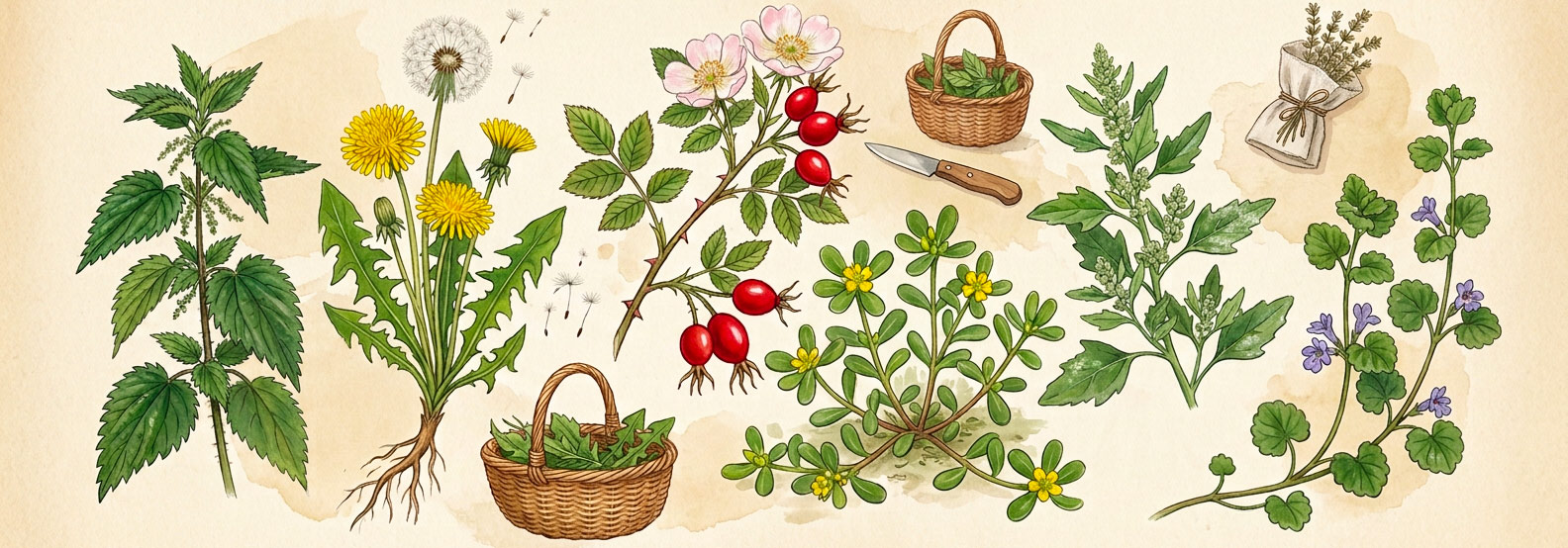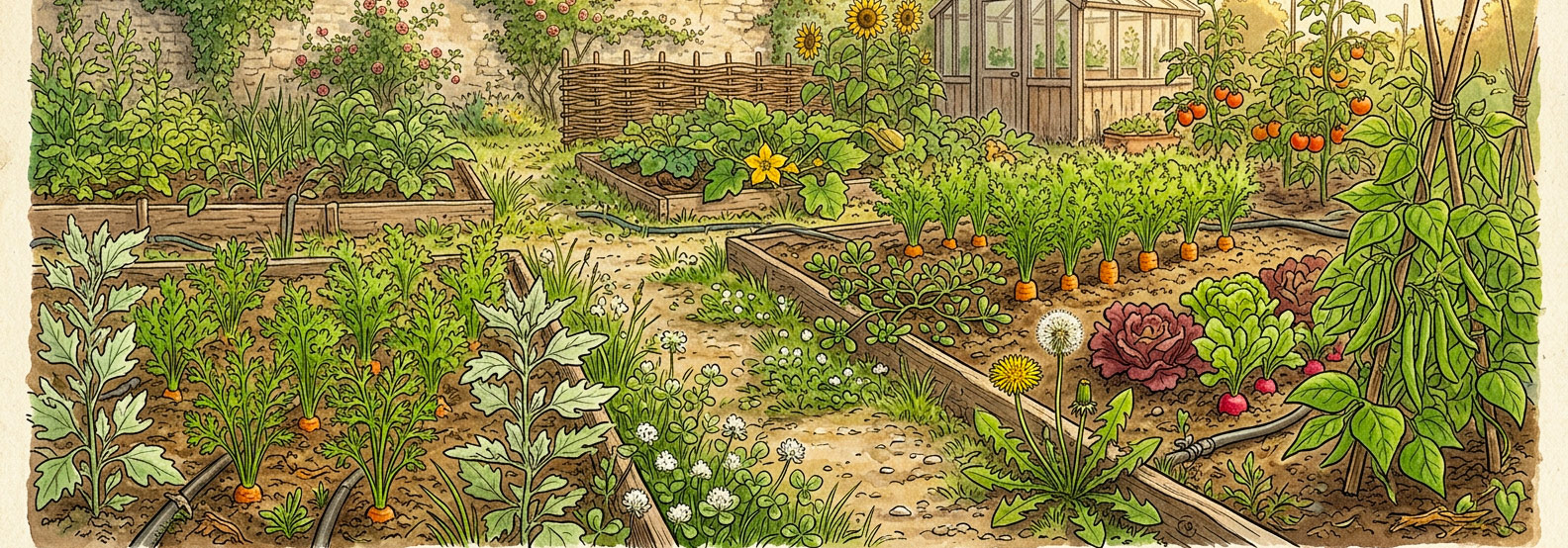
We pull it up without a second thought.
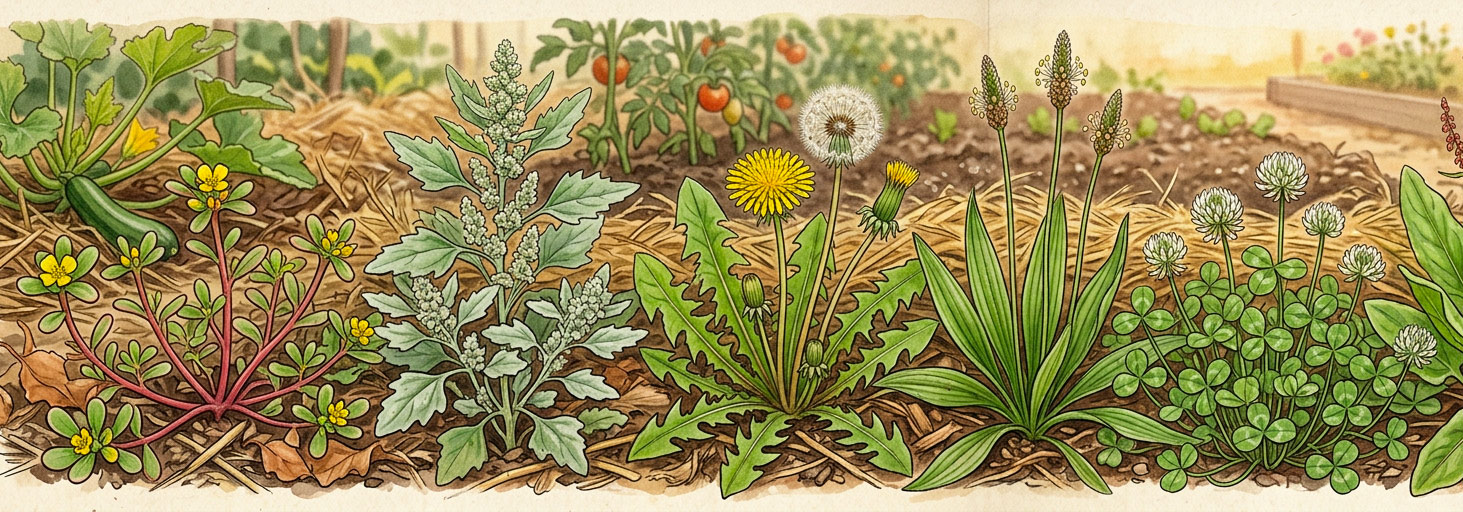
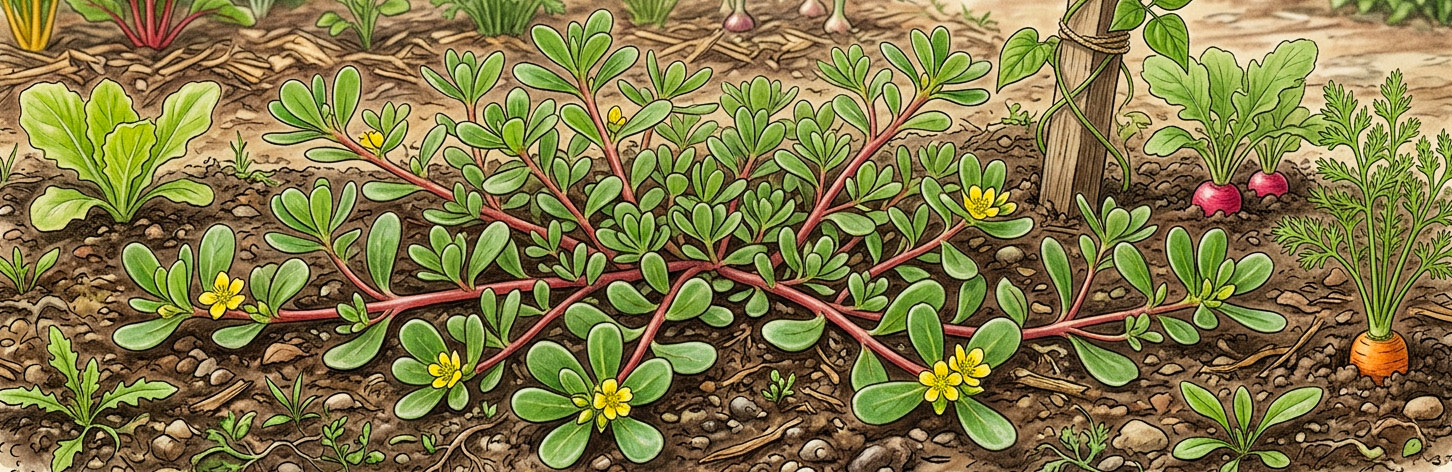
Purslane grows flat to the ground, threads its way between the vegetables and passes easily for just another weed. And yet Portulaca oleracea is thoroughly edible, and its flavour is mild, green and understated.
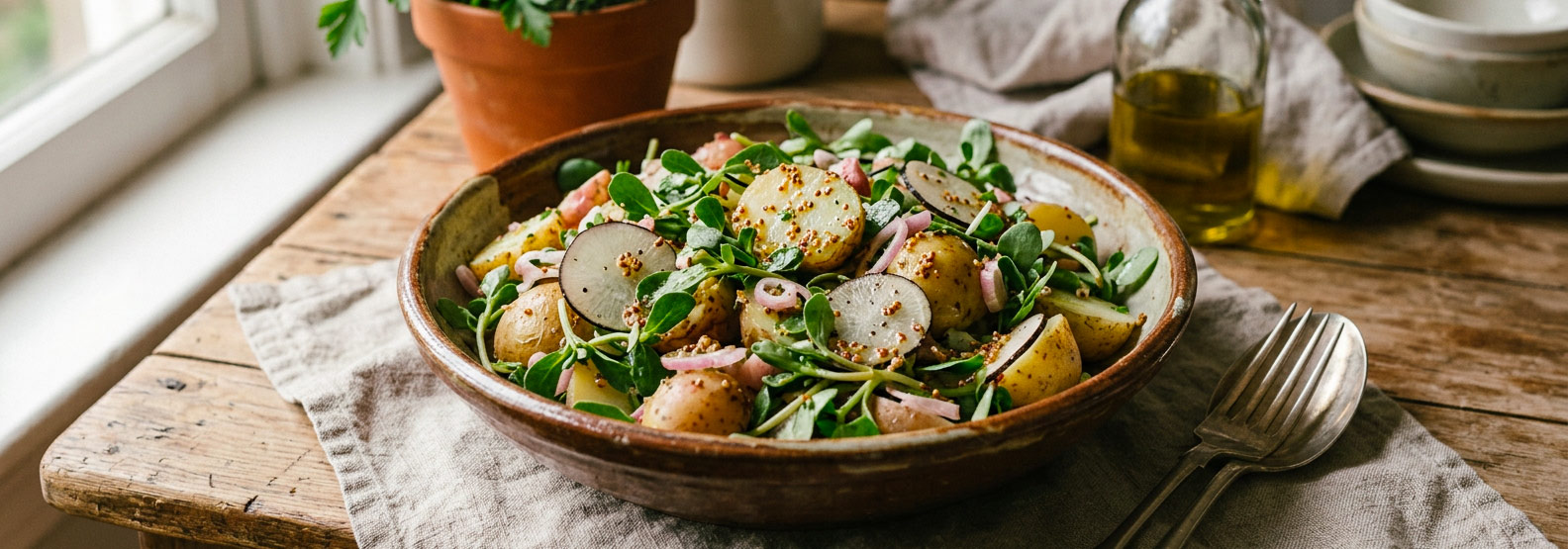
There's no need to turn it into anything complicated. At my place it simply ended up raw in a potato salad.
My potato and purslane salad
I went for something very simple.
For the salad
- cooked potatoes, still warm;
- raw purslane leaves, a good handful or two;
- one banana shallot, finely sliced;
- a few thin slices of black radish.
For the dressing
- olive oil;
- vinegar;
- wholegrain mustard.
I leave the black radish to sit in salt for half an hour before adding it. That takes the edge off its rather aggressive bite, and it becomes far pleasanter to eat.
For the purslane, I use only the leaves, raw, to keep their slightly fleshy texture. The young stems are edible too, but they're more fibrous.
With smoked sausage, this makes a complete and fairly rustic salad. For a vegetarian version, swap the sausage for pan-fried tofu.
Raw or cooked?
The young leaves and stems can be eaten raw: in salads, with tomatoes, with potatoes, in a sandwich, or mixed with other young leaves.
You can also cook it, in soups, in omelettes, or quite simply the way you'd treat spinach.
Why it's more than a filler leaf
Purslane has a nutritional profile that's rather unusual for a plant we pull up.
Its omega-3
This is probably its best-known feature. A number of studies describe purslane as one of the best plant sources of omega-3 among leafy vegetables. It contains alpha-linolenic acid, or ALA.
Be careful not to confuse these plant omega-3s with the ones found in oily fish, though. ALA has to be converted by the body to produce EPA and DHA, and that conversion is limited.
None of which takes away from purslane's value as a vegetable. It simply means a handful of leaves doesn't replace a food rich in EPA or DHA.
Vitamins, carotenoids and minerals
Purslane isn't just its omega-3. Its composition varies a great deal with the variety, the growing conditions and when it's picked, but analyses have shown notably:
- vitamin C;
- vitamin E;
- carotenoids, including beta-carotene, lutein and zeaxanthin;
- magnesium, potassium, calcium and iron;
- various phenolic compounds and antioxidants.
So it's an interesting plant mainly because it makes it easy to add a bit of plant diversity to what you eat.
Can we really talk about "health benefits"?
This is where you have to separate what a plant contains from what it cures.
You often read that purslane has antioxidant and anti-inflammatory properties. Those properties have indeed been observed in the laboratory and in animals. But between a concentrated extract tested in a test tube and a few leaves in a salad, there's a world of difference.
"On the plate, its appeal is far simpler: it's an edible wild vegetable, low in calories and rich in several useful nutrients. And that's already plenty."
There are still a few precautions
And this is the important part.
Purslane is high in oxalates
Purslane can contain fairly high levels of oxalic acid and oxalates. The amount varies a great deal between plants and growing conditions, but it's one of the main nutritional limits of the species.
For most people, eating it occasionally as a vegetable poses no particular problem.
But anyone who has to follow a low-oxalate diet, in particular because of a history of calcium oxalate kidney stones, would do well to be more careful and follow their healthcare professional's advice.
Boiling it and discarding the water reduces some of these compounds. But if you're simply eating a few raw leaves in a salad, there's nothing to worry about. Just not every day and by the bowlful, rabbit-style.
Mind where you pick it
As with all edible wild plants, it's best to avoid purslane growing near a busy road, in an area that may have been treated with herbicides or pesticides, on ground whose history you don't know, or in places heavily frequented by pets.
And above all, be sure of the identification
Purslane has thick, fleshy stems, often reddish, and small smooth succulent leaves. Don't confuse it with prostrate spurge, which grows in the same conditions and sprawls the same way. The difference shows instantly: snap a stem. Purslane gives nothing, spurge leaks a white latex. Spurge is toxic.
A weed that may deserve a second look
Purslane deserves neither to be presented as a miracle remedy nor to be systematically pulled up as a useless plant.
It's simply an edible volunteer plant, long known in several cuisines, with a nutritional make-up that's quite remarkable for something many people still regard as a weed.
So now, when I find some in the vegetable patch, I no longer pull it up automatically without thinking.
Some of it occasionally ends up... in the salad.