We pull them out. We throw them away. We grumble because they're back three days later, and worse, they grow far better than the plants we actually chose.
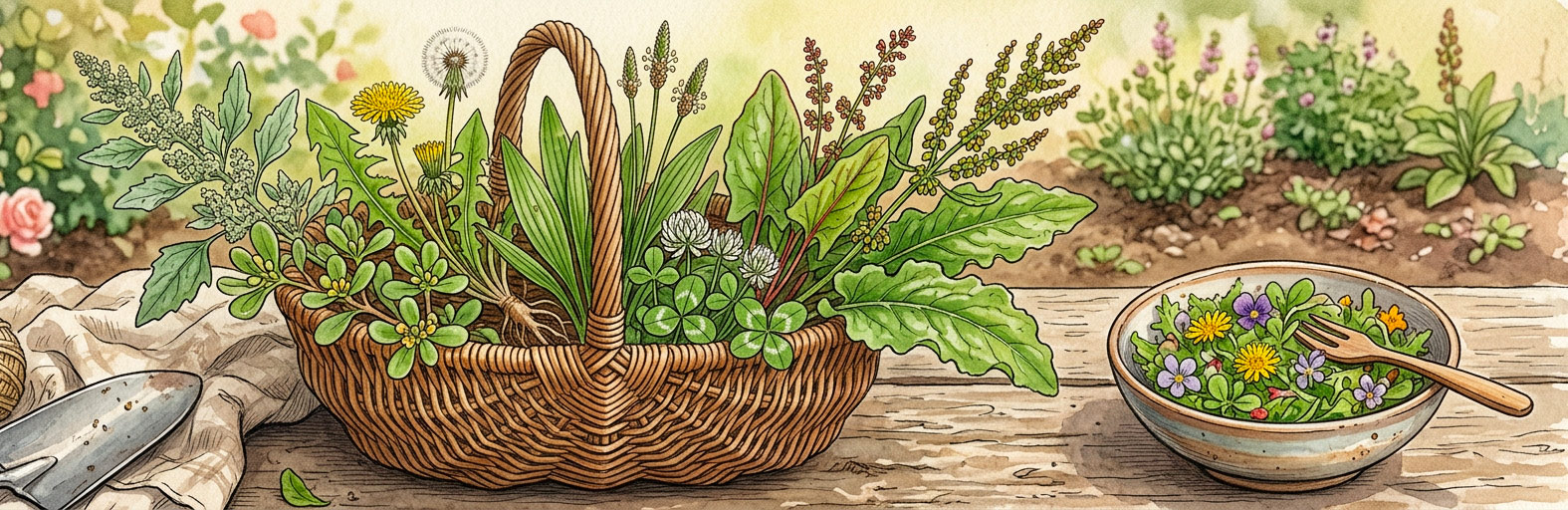
And yet some of our "weeds" are edible: they've been used for centuries in country kitchens. So before reaching for the hoe, here's a look at a few plants that deserve a second glance.
Purslane
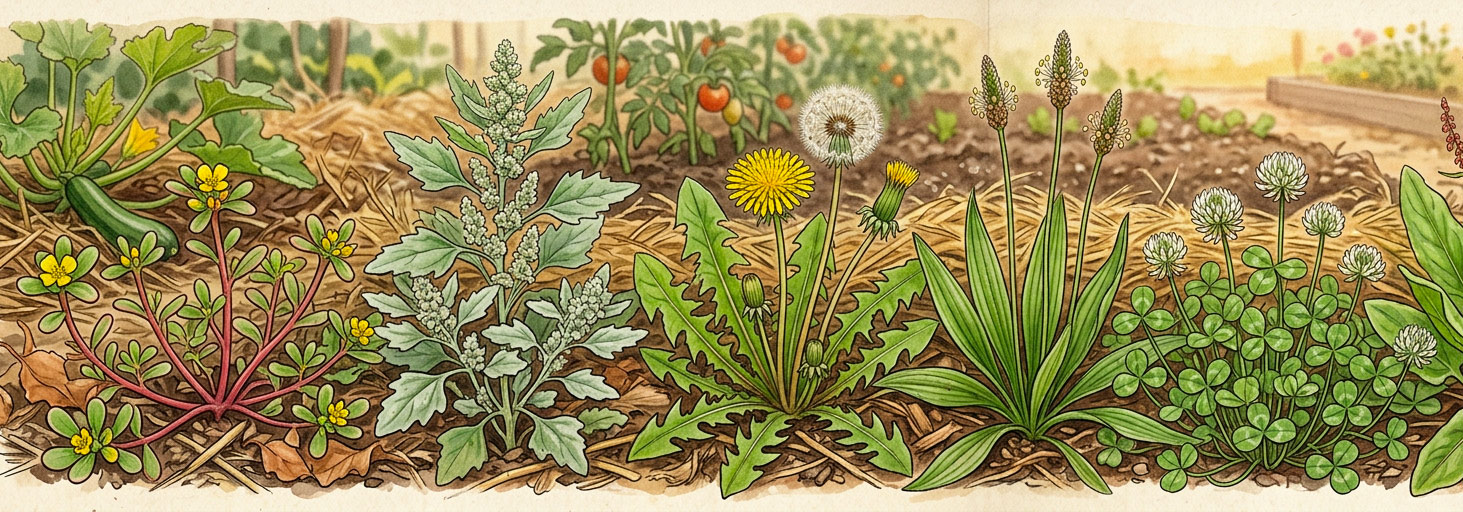
Purslane (Portulaca oleracea) is one of the most interesting examples. This low, creeping plant with thick, fleshy leaves grows readily in hot, dry, well-exposed spots.
And it's edible. Its young stems and leaves are traditionally eaten raw in salads, but also used in soups and cooked dishes across several regions of Europe and the Mediterranean basin.
What really sets purslane apart, though, is its composition. Among leafy greens, it stands out for its content of alpha-linolenic acid (ALA), a plant-based omega-3 fatty acid. One scientific review describes it as a particularly notable source of omega-3 among green vegetables, alongside potassium, magnesium and vitamin C.
So that little green mat you pull up between rows of tomatoes? You could start by tasting a leaf. It's crisp, lightly tangy, with an almost succulent texture.
How to use it:
- Raw in a salad
- With tomatoes
- In a soup
- Lightly sautéed
- Mixed with other young leaves
Lamb's Quarters
Lamb's quarters (Chenopodium album) has almost certainly passed through your hands already. It pops up on its own in cultivated soil, vegetable beds and rich ground.
And yet its young leaves and shoots have been eaten as a vegetable in many regions. They can be cooked like spinach, added to soups, and would probably work well in a savoury cake too. Archaeological evidence even shows lamb's quarters was eaten in Europe as far back as the Iron Age, into Roman times and the Viking era.
It has a solid nutritional profile, notably a high vitamin C content. But there's an important detail: like spinach or sorrel, lamb's quarters also contains oxalates. Cooking, especially boiling, helps reduce some of this.
How to use it, young leaves and shoots:
- Cooked like spinach
- In a soup
- In an omelette
- Mixed with other vegetables
For regular or larger amounts, it's best to cook it and discard the cooking water.
Good to know: oxalates
Both lamb's quarters and wild sorrel contain oxalates, much like spinach. Occasional consumption isn't an issue for most people, but it's best not to overdo it, especially raw and in large amounts, particularly for anyone prone to kidney stones.
Dandelion: Almost the Whole Plant Is Edible
Dandelion (Taraxacum officinale) is perhaps the most famous "weed," and probably the one most unfairly cast as the lawn's arch-enemy. We've all knelt in the grass, knife in hand, because the roots are genuinely not the easiest thing to dig out.
In Europe, its young leaves were eaten raw in salads, often paired with eggs, potatoes or walnut oil. They were also cooked in soups, omelettes, or served as a vegetable.
But it's not just the leaves. The flowers have been used to make syrups, drinks, and preparations close to "dandelion honey." They also served as a natural yellow food colouring. The roots, roasted, were used as a coffee substitute, much like chicory.
How to use it:
- Young leaves in a salad
- Older leaves cooked
- Flower buds pickled in vinegar
- Flowers made into syrup
- Roasted roots
Older leaves, though, become noticeably more bitter, sometimes almost sharp, and too tough for salads.
Narrowleaf Plantain
Narrowleaf plantain (Plantago lanceolata) grows in lawns, along paths, at the edges of vegetable beds: basically, wherever you happen to walk. And yet it has a long history of use.
The leaves can be added to salads, egg dishes, meat or vegetable preparations. The young leaves are the most interesting: more tender and less fibrous than the larger, older ones. The flavour is fairly green and vegetal, sometimes slightly bitter or vaguely mushroom-like.
How to use it:
- A few young leaves in a salad
- Chopped into an omelette
- Cooked with other vegetables
- In a soup
Older leaves turn tough quite quickly: those are best left to get trampled underfoot.
White Clover
White clover (Trifolium repens) is everywhere: lawns, paths, garden edges. And it's not just there for the bees.
White clover leaves and flowers can be sautéed with potatoes and onions, while the flowers have also been used to flavour bread. They contain various flavonoids, including rutin and quercetin.
How to use it:
- A few flowers in a salad
- As a small decorative touch
- In cooked preparations
- Young leaves with other vegetables
This stays firmly in occasional-use territory, though: not a full bowl of clover salad.
Wild Sorrel
Under the name "wild sorrel," you'll find several species of the genus Rumex, notably Rumex acetosa and Rumex acetosella. What they share: that very distinctive tangy flavour.
The leaves of several Rumex species are eaten in Europe, notably raw in salads or cooked into soups, sauces and egg dishes. Their tartness comes partly from their oxalic acid content, which is exactly why a little moderation is called for. You can eat it, yes, just not morning, noon and night.
How to use it, in small amounts:
- In a salad
- In a soup
- In a sauce
- With eggs
A few leaves are plenty to bring the tang.
"Some of our 'weeds' are edible: they've been used for centuries in country kitchens."
None of this replaces proper weeding when these plants take over a bed or crowd out a seedling. But next time a patch of purslane or dandelion shows up between two rows, it might be worth a second look before it heads to the compost.