For a long time I had a fairly simple rule in the garden. A plant was growing where I hadn't sown it? I pulled it up.
And then, from paying closer attention to what comes up on its own between the vegetables, the question eventually surfaces: are we sometimes removing plants that do us a few favours anyway?
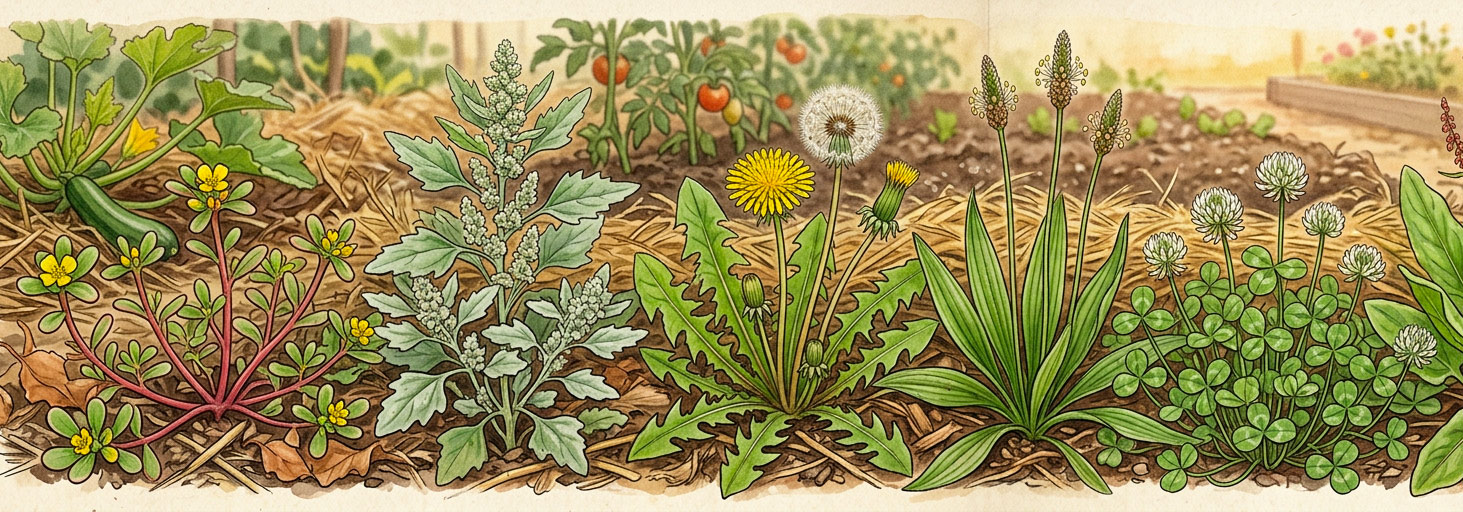
Purslane, clover, plantain, dandelion, lamb's quarters... all of these get filed under a single heading: weeds. The word is convenient. It's also fairly unfair.
In agronomy the term is different. These are volunteer plants, growing in a crop without having been deliberately put there. They aren't "bad" by nature. They simply arrived on their own, sometimes in the right place... sometimes considerably less so.
A plant is mostly a problem when it's in the wrong place
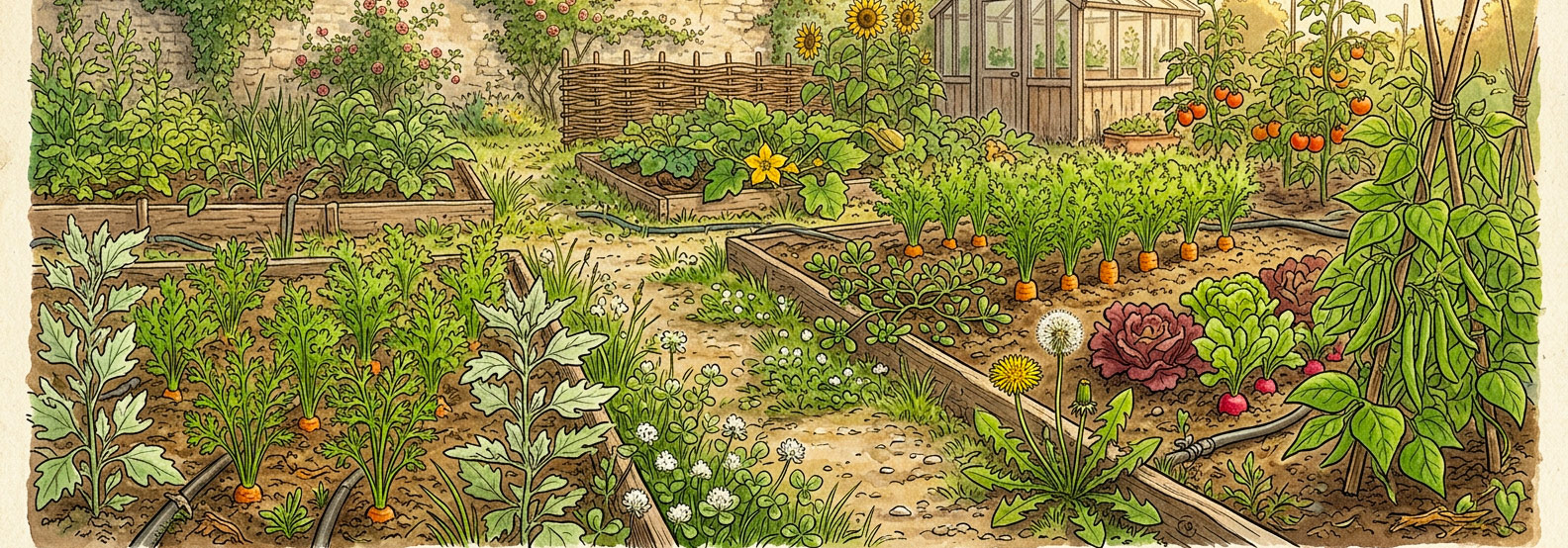
Clover growing along a path isn't the same problem as clover swamping a row of carrots that have only just come up.
A mat of purslane under big, well-established tomato plants doesn't compete in the same way as a tall, vigorous plant taking all the light.
"The plant hasn't changed. What changes our judgement is where it stands."
And that's probably a better way to think about weeding.
Bare soil isn't necessarily happy soil
For a long time we've associated a beautiful vegetable garden with perfectly clean earth, dark and bare between every row. It looks immaculate. Social media loves it. Pinterest too. The garden itself, rather less.
In fact, when I filmed my garden after coming back from holiday, following yet another heatwave, with all the leaves from the neighbouring tree strewn across the ground, I got criticism: abandoned, neglected. I decided to leave it all. Are you joking? Free mulch, and I didn't even have to bend down.
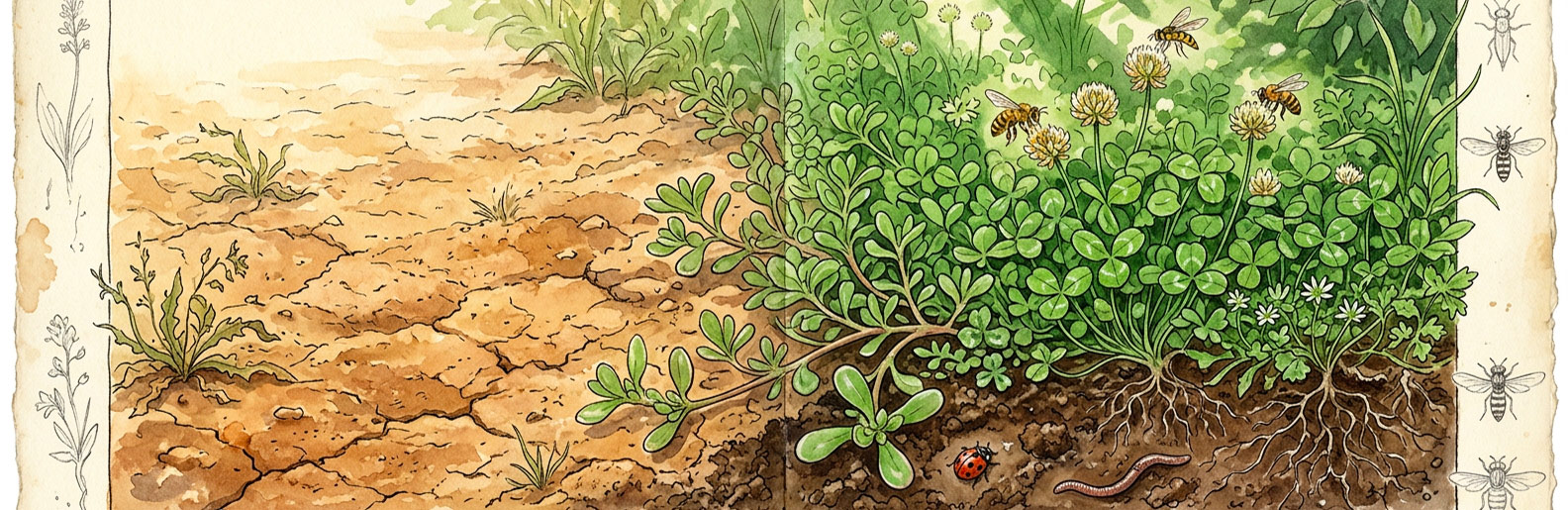
And it's true that bare earth is directly exposed to sun, wind and heavy rain. Low-growing vegetation can play part of the role we look for in mulch: protecting the surface, limiting erosion, keeping living roots in the soil.
This doesn't mean an overrun bed is better than a mulched one. Simply that covering the soil with living plants can also have its uses. In the Rustica article that got me thinking about all this, the author recommends tolerating low, sparse vegetation rather than always aiming for bare ground. In the middle of a hot summer, that's worth at least a second look.
Some of them feed insects, too
There's also everything happening above the soil. A volunteer plant left to flower becomes a potential source of pollen or nectar.
The dandelion is a good example: the Royal Horticultural Society actually recommends letting some lawn weeds flower, and names the dandelion as an important food source for many pollinators.
More broadly, a garden holding a wider range of plants and flowers offers insects more options than a space where everything not deliberately planted gets removed. No need to turn the garden into a jungle, neighbours can be as sharp as social media, but encouraging biodiversity does some good. Between pulling everything and losing all control, there's a comfortable amount of room.
They can also give you clues about your soil
This is another reason I started looking at them differently. Some species turn up more readily in certain soil types or conditions: compacted ground, damp ground, rich ground, frequently worked ground.
You sometimes hear: "You've got this plant, so your soil is short of that element." I'd be wary of that kind of instant diagnosis. One plant is no substitute for a soil test.
But watching which species come back year after year in the same spot can be genuinely informative. A group of volunteer plants tells you at least something about the conditions in which they manage to thrive, given that we make no effort whatsoever to help them. And that's already far more useful than pulling them without so much as a look.
Of course, they compete with us too
Because it would be a mistake to swing too far the other way. Volunteer plants use exactly the same resources as our vegetables: water, light, space and nutrients. They really can reduce crop growth when they get too numerous or too vigorous.
INRAE, the French agricultural research institute, points to this double reality: these plants can play an important role in farmland ecosystems while also competing with crops. The challenge is to encourage some of the benefits without penalising production.
So around a young sowing of lettuce or carrots, I keep weeding. Without a shred of guilt.
They don't all need the same treatment
This is probably where it gets interesting.
- Purslane, very low and creeping, can sometimes be tolerated where it isn't bothering the vegetables.
- White clover has a place along a path or in a lightly cultivated corner.
- Dandelion can feed pollinators when it flowers, but that thick taproot soon gets in the way wherever I want to work the soil.
- Lamb's quarters can end up far taller: if I want to keep it around a while, it's best not to wait until it towers over the crops and scatters seed everywhere.
And some species are so invasive or so competitive that there's no real debate: they have to be controlled.
The word that matters
In the end the important word is perhaps simply this: control. Not exterminate. Not let it run. Control.
What if we weeded differently?
I think what's really changed is how I look at the garden. Before: "I didn't plant it, so I pull it." Now I ask myself three questions.
- Is it genuinely getting in the way of a crop?
- Is it likely to become invasive?
- Could it be useful where it's growing?
If it's smothering my vegetables, out it comes. If it's quietly preparing 30,000 seeds for next year, it generally loses the argument. But if it stays low, fills an empty patch and bothers nobody, it can sometimes stay.
Weeds, or plants in the wrong place?
The word "weed" will probably never disappear. It's too convenient. But the agronomic term is a useful reminder: this isn't a botanical category of useless plants. These are simply plants growing where we hadn't planned for them.
Some really do become a nuisance. Some can be useful. And plenty are a bit of both, depending on where they come up.
So no, I'm not going to stop weeding my vegetable garden. But I'll probably carry on doing what I started this year: looking before pulling. It's slower. You also discover a great deal more.
FREE GUIDE
What Weeds Can Tell Us About Our Soil
Want to look at your garden weeds differently? Two printable pages to help you spot what they may suggest about your soil, and what to check before acting.
- →10 common weeds and the clues they can give;
- →what to check in your own ground;
- →a few simple actions to consider in the garden.