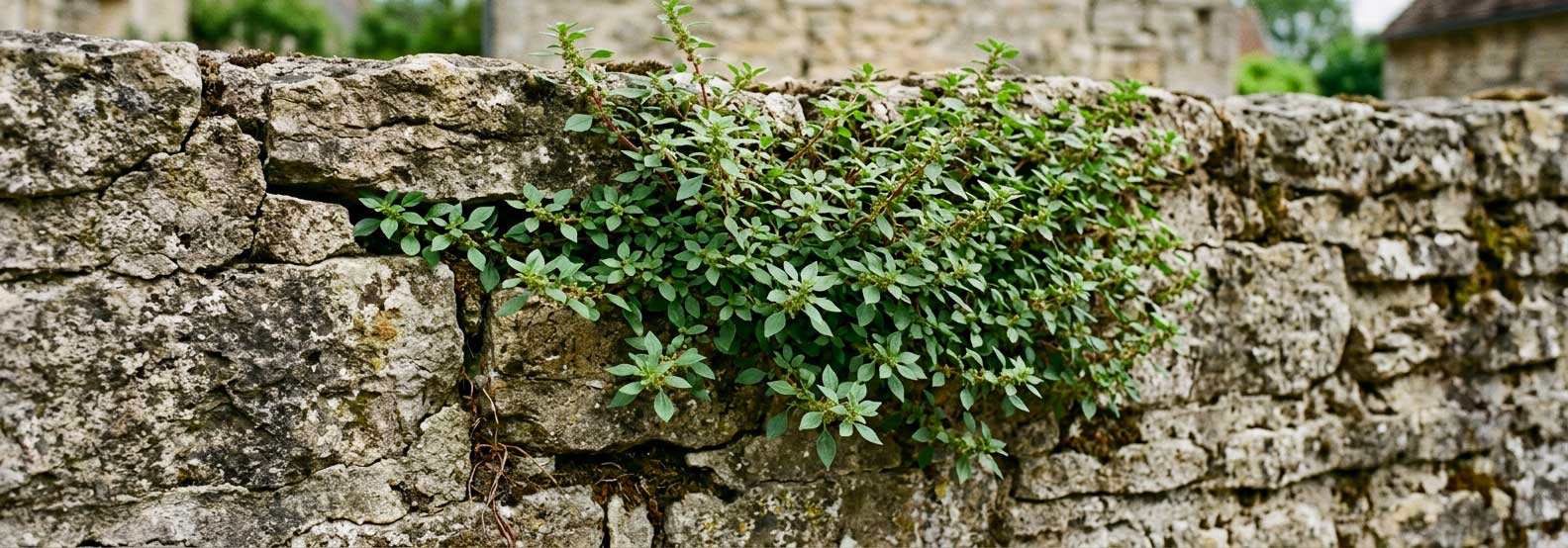
It grows at the foot of old walls, between stones, in the cracks of pavements: anywhere nothing else wants to grow. We walk past without seeing it. And yet our ancestors picked it for one very specific job: washing bottles.
It's no coincidence that one of its species, Parietaria officinalis, still goes by the French nickname herbe à bouteille, the "bottle herb". Before it became a weed to pull, pellitory was a household product. Free, delivered to the doorstep, and with no plastic packaging.
A plant of old walls
Pellitories belong to the same family as nettles, the Urticaceae. Good news: they don't sting. They got the family's discretion, not its temper.
Two species are especially common in France:
- Upright pellitory (Parietaria officinalis), the one nicknamed "bottle herb";
- Pellitory-of-the-wall (Parietaria judaica), which loves old walls and stony corners.
The name says it all: Parietaria comes from the Latin paries, wall. A rather ordinary plant, then. But in the old days, being ordinary was exactly its strength: it grew within arm's reach. A bit as if sponges grew in the garden. (Yes, I know, that exists: it's called a luffa. But it doesn't grow between paving stones.)
The ancestor of the bottle brush
Before bottle brushes, detergents and dishwashers, cleaning the inside of a bottle was no fun at all. Let's be honest: even today, it's not exactly a breeze.
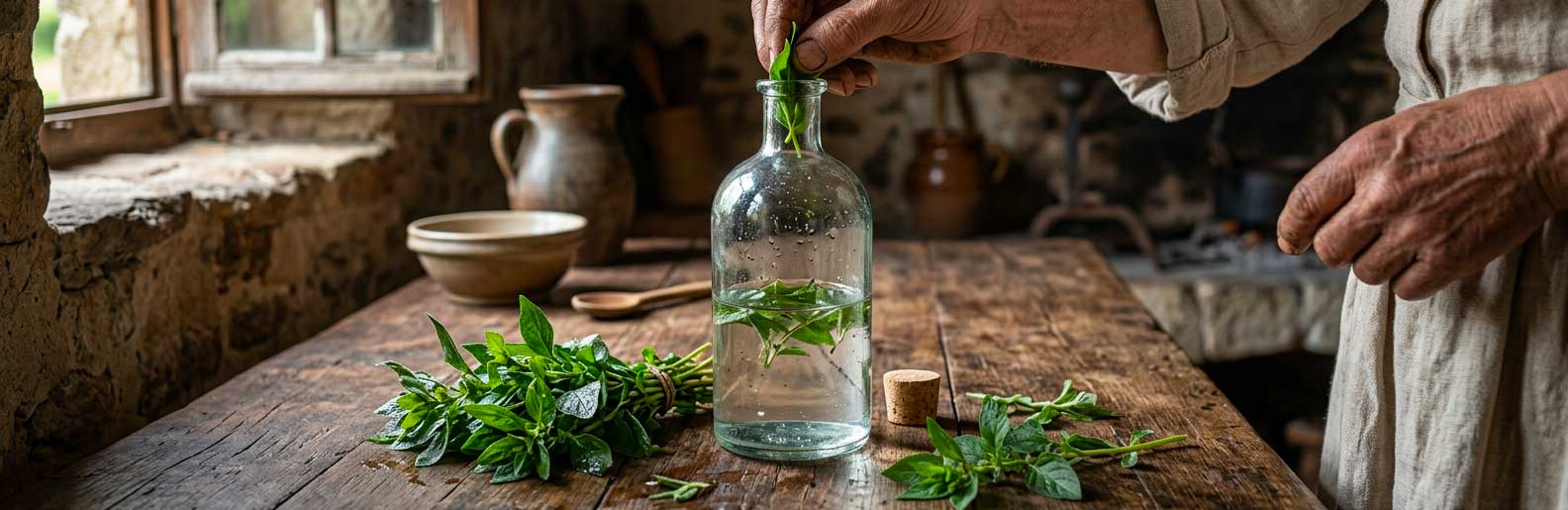
Pellitory offered an almost insultingly simple solution. A text published in 1841 tells how an army doctor watched a soldier scrub out a bottle that had held oil using this plant. Intrigued by the result, he tried it himself. The method: a few leaves in the bottle, a little water, and shake. That's it.
The plant was also used to clean and polish glass, mirrors and various utensils. And the same text points out that the trick was nothing new in 1841. Right up to the mid-twentieth century, household manuals passed it along from one book to the next: for washing bottles, nothing beats pellitory.
Why does it work?
Pellitory wasn't just a handful of leaves playing makeshift brush.
Its leaves have a slightly rough surface. Shaken with water in a bottle, they rub against the glass and loosen deposits.
And there may be a little chemical boost on top. Pellitory is rich in potassium and sodium, the same elements found in wood ash and washing soda, both used for cleaning in the old days.
Bottle brush and washing-up liquid: pellitory, the original 2-in-1!
A much older practice
The story doesn't start in the nineteenth century. Medieval Arabic texts, studied by researchers David Iluz and Zohar Amar, show that Parietaria judaica was already used to clean glass in the Middle Ages, in Palestine and Syria. The scholar Al-Biruni mentions it for cleaning mirrors, glassware and bottles.
So here is a "weed" everyone ignores today, which did the housework for nearly a thousand years.
Can you try it today?
The historical method is simple:
Put a few pellitory leaves in the bottle.
Add a little water.
Close it and shake vigorously.
Remove the leaves and rinse.
It's mostly a fun experiment to rediscover an old gesture. For a bottle that will hold food or drink, finish with a proper wash anyway. The charm of history is no substitute for hygiene.
Watch out
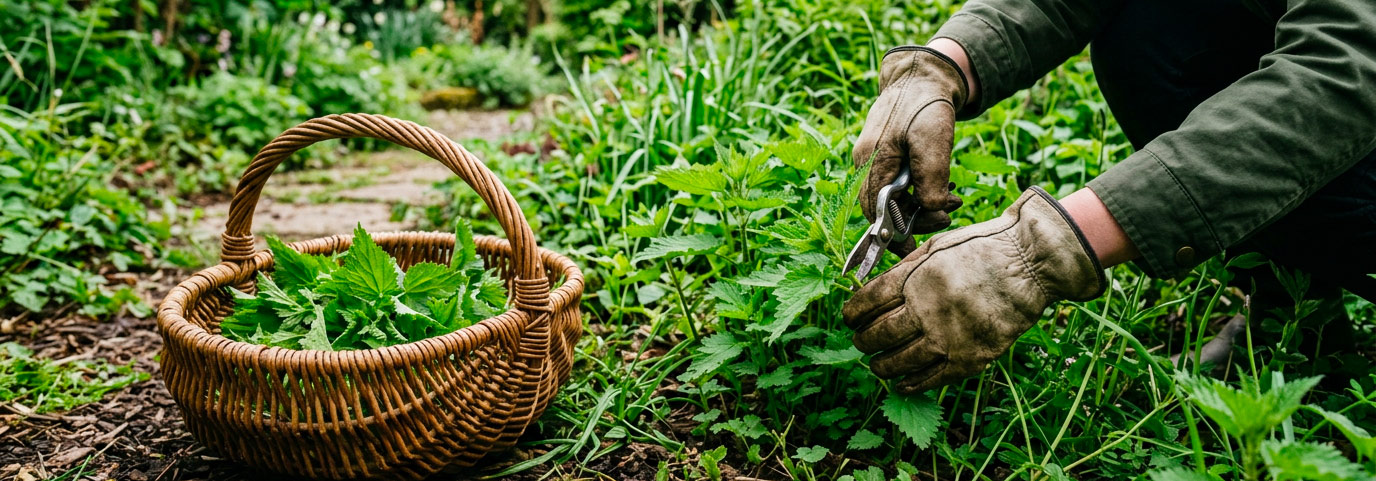
Pellitory pollen is one of the most allergenic there is, especially around the Mediterranean. If you suffer from hay fever, wear gloves when picking it and avoid the flowering season.
A plant worth a second look
That's the whole charm of these old habits. Where we see a weed between two stones, which most of us couldn't even name, people in the past saw a free, useful resource right on their doorstep.
Its old nickname, "bottle herb", suddenly makes perfect sense. A little wall plant, an almost forgotten gesture, and not a single cleaning product to buy. Exactly the kind of trick that deserved to come out of the old books.