Cuttings, layering, suckers, or grafting: not every fruit tree propagates the same way. Here's how to pick the right method without losing several years in the process.
Planting a peach pit or a few apple pips is tempting. After all, if a seed produced the first tree, why wouldn't it grow an identical one? Unfortunately, it's usually not that simple.
A fruit tree grown from a pip or a pit is the result of sexual reproduction. It carries a mix of traits from both parents and won't necessarily reproduce the original variety. A pip taken from an excellent apple can grow into a vigorous tree — but one with small, sour, or unremarkable fruit.
To preserve a fruit tree's qualities — its flavor, color, harvest time — you need a vegetative propagation method. The new plant then carries the exact same genetic makeup as the piece taken from the original tree. But not every technique suits every fruit tree.
Before you start: find the graft union
Most apple, pear, cherry, plum, and peach trees sold commercially are actually two plants joined together: the rootstock, which forms the roots and influences vigor, size, and soil adaptation, and the scion, which produces the chosen fruit variety. The graft union usually shows as a visible bulge near the base of the trunk.
Watch out
A sucker growing below the graft union belongs to the rootstock. Propagating it won't give you a copy of your apple or plum tree — it'll give you its rootstock instead. Grafting exists precisely to pair the fruit of an interesting variety with the hardier or less vigorous roots of another plant.
Which method for which fruit tree?
| Fruit tree | Generally best method |
|---|---|
| Fig | Hardwood cutting, layering, or sucker |
| Grapevine | Hardwood cutting |
| Blackcurrant | Hardwood cutting |
| Gooseberry / currant | Hardwood cutting |
| Raspberry | Sucker removal |
| Blackberry (bramble) | Tip layering |
| Citrus | Cutting, air layering, or grafting |
| Apple | Grafting or budding |
| Pear | Grafting or budding |
| Plum | Grafting, sometimes suckers depending on type |
| Cherry | Grafting or budding |
| Peach / nectarine | Grafting or budding |
Figs, grapevines, blackcurrants, and gooseberries are among the most beginner-friendly fruit trees for cuttings. Apples, pears, plums, and cherries, on the other hand, are usually grafted.
Cuttings: the simplest solution
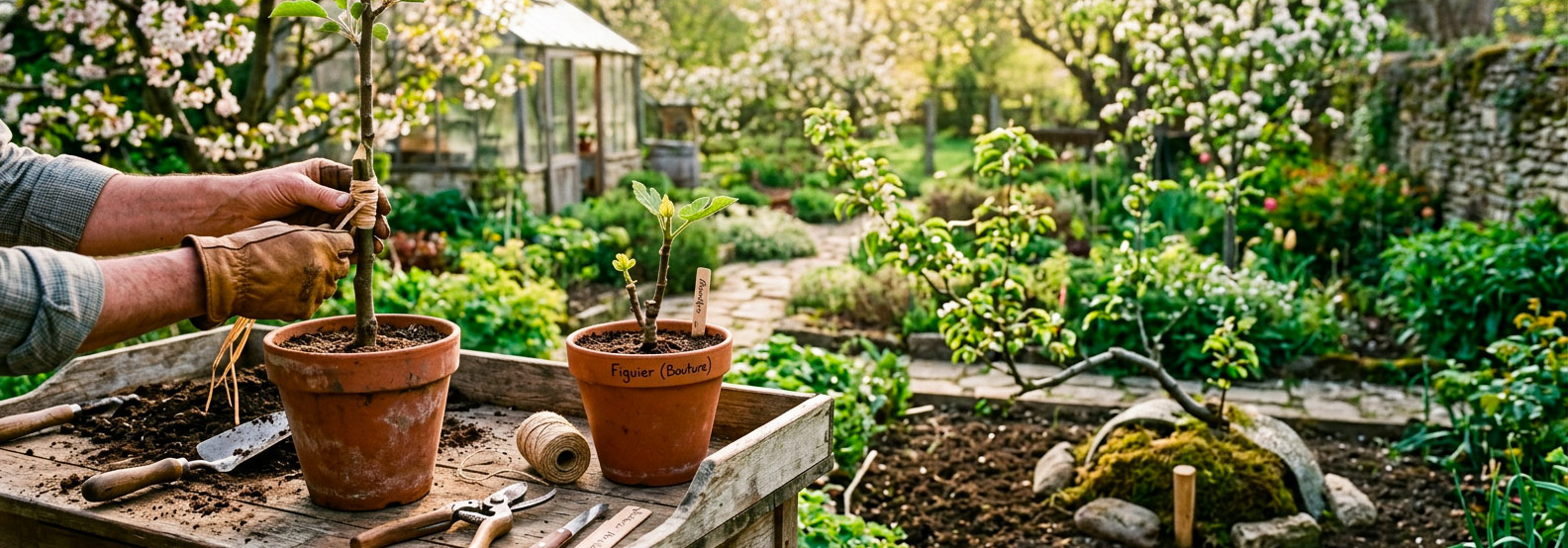
Taking a cutting means removing a piece of stem and helping it grow its own roots. It's particularly well suited to figs, grapevines, blackcurrants, gooseberries, some mulberries, and some citrus.
Hardwood cuttings
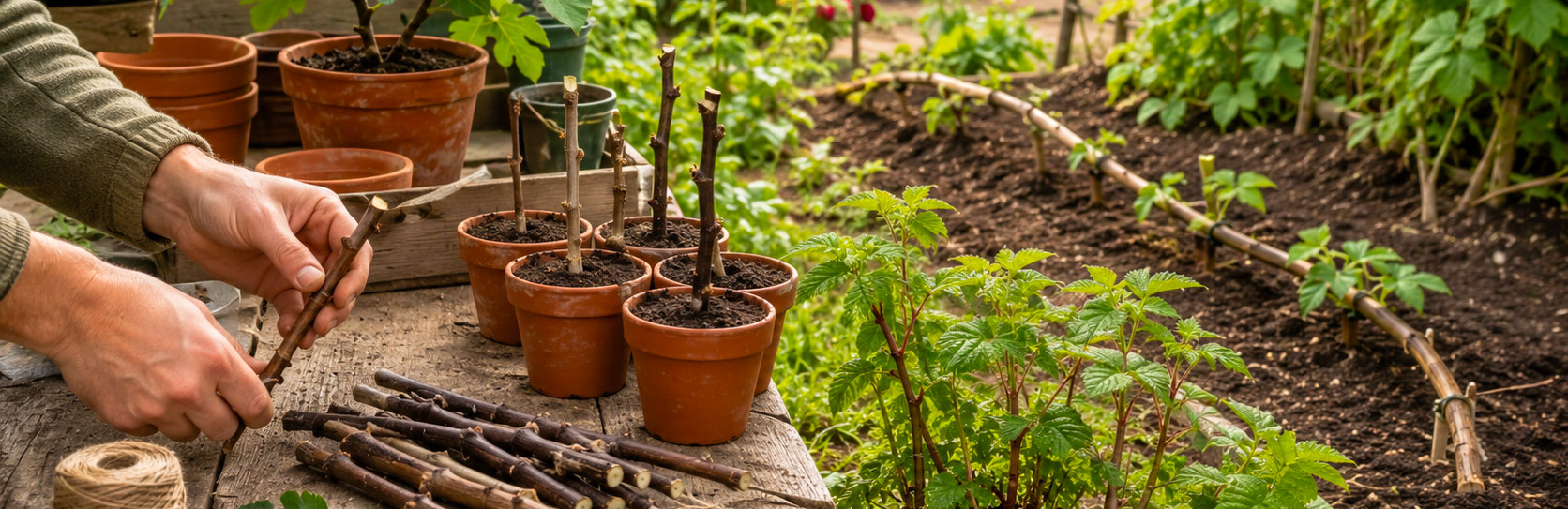
Taken while the plant is dormant, generally between leaf fall and late winter. Choose a healthy stem grown that year, firm but still flexible. Cut a section about 20 to 25 cm long with several buds on it.
Plant it in a light mix or straight into well-drained soil, leaving one or two buds above ground. Keep the soil lightly moist, never soggy. Roots develop slowly — the cutting may look completely still for weeks, so avoid digging it up to check.
Softwood cuttings
Taken in spring or early summer from a still-green, flexible shoot. It sometimes roots faster, but it's also more prone to drying out, and needs a humid, bright spot away from direct sun. This method can work well for some citrus.
Layering: growing roots before you cut
Layering means encouraging a branch to root while it's still attached to the parent plant. It's a reassuring method: until it has enough roots, the future plant keeps receiving water and nutrients through the original branch.
Ground layering
Choose a low, flexible branch, bend it to the ground, bury a section lightly, and hold it in place with a hook or a stone. The tip should stay above ground. Once roots are well formed, separate and replant. This works especially well for blackberries, which root easily wherever the tip of a long cane touches the soil.
Air layering
When a branch can't be bent to the ground, it can be rooted directly on the tree: a small strip of bark is removed or scored, the area wrapped in damp sphagnum moss, then covered to hold moisture. Once roots are visible, the branch is cut below the new root ball. Useful for woody plants that root poorly from cuttings, though not a universal solution for every tree.
Suckers: easy, but watch the trap
Raspberries naturally send up young shoots from their roots. These suckers can be separated in spring, as long as you keep a small piece of root attached, then replanted elsewhere — one of the simplest ways to expand a raspberry patch for free.
Caution is needed with grafted trees, though: a sucker appearing below the graft union belongs to the rootstock and won't produce the same fruit as the top of the tree. Always check exactly where it originates before taking it.
Grafting: essential for many fruit trees
Grafting means attaching a piece of the variety you want to propagate onto a compatible rootstock. The scion produces the branches and fruit; the rootstock supplies the roots and shapes the tree's final size and behavior in the soil. This method is especially used for apples, pears, cherries, plums, peaches, and nectarines.
Grafting requires more precision than taking cuttings: the tissues of scion and rootstock must be aligned correctly, protected from drying out, and held firmly until they fuse. Stone fruit and pip fruit are usually propagated this way, since they often root poorly from cuttings and the rootstock lets you control their vigor.
Five rules that improve your odds of success
- Only take material from a healthy plant, free of cankers, dieback, distorted leaves, or unexplained symptoms — vegetative propagation faithfully reproduces the variety, but it can also pass on viruses and pathogens present in the parent plant
- Clean and disinfect your pruning shears before each cutting, especially when moving from one tree to another
- Time it right for each method: softwood cuttings in spring or early summer, hardwood cuttings from autumn to late winter, suckers preferably in spring, layering in spring or autumn
- Keep several cuttings rather than just one, so you can discard the weaker ones and keep only the well-developed plants
- Write everything down: variety name, date taken, method used, and where the parent plant is located
Good to know
In the European Union, acts carried out privately and for non-commercial purposes fall under the exceptions provided by regulations on Community plant variety rights. Selling, producing for sale, or professionally distributing protected plant material, however, follows different rules.
In short
To easily propagate fruit trees without buying new plants, start with the most forgiving species: take cuttings from a fig, a grapevine, or a blackcurrant, remove suckers from a raspberry patch, layer a blackberry cane, and save grafting for apples, pears, plums, and cherries.
"Propagating a fruit tree isn't complicated once you pick the right method. The real secret isn't a miracle rooting powder — it's respecting each species' biology."