A tomato is easy: when it's red, you pick it. A carrot, on the other hand, lives its life underground without telling anyone a thing. So when should you harvest it? And what on earth has been growing down there all this time? The story of a harvest full of suspense.
When should you harvest a carrot?
First question, and not a small one: when?
Well yes, it all happens underground, you can't see a thing. A tomato is easy: you wait for it to turn red. But a carrot??? Some say you should wait until the shoulder shows under the leaves. Others say six months, on the dot.
Right. It had been six months, maybe more, and I still couldn't see any shoulders. So I decided to grab my spade. (Maybe not the right tool. Spoiler: no. A garden fork does far less damage to the roots.)
Good to know
Most varieties are ready 3 to 5 months after sowing: a little less for early carrots, a little more for storage types. To check without pulling everything up, scrape away the soil at the base of the leaves and look at the width of the top of the root.
The moment of truth
And then comes the surprise.
A big, fat root? A completely wonky carrot? Something weird? What has been growing all this time? I watered, I weeded, I tried to follow every step of carrot growing to the letter… so what happened?
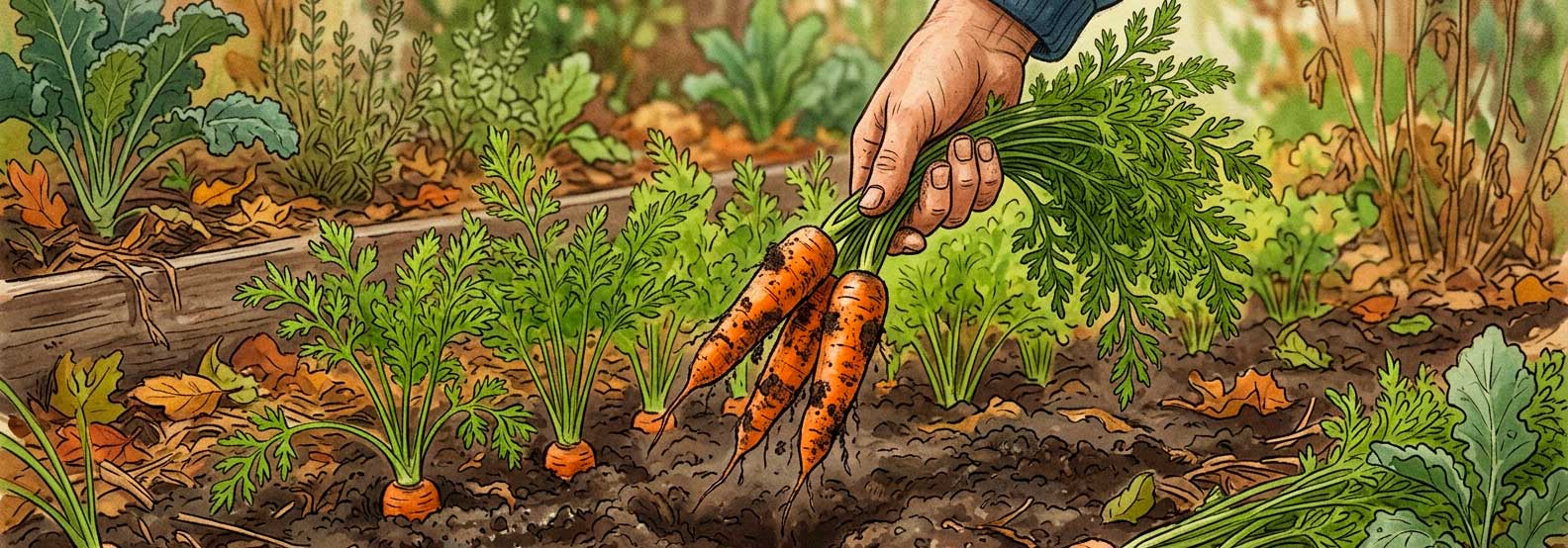
Answer: a row of tiny carrots.
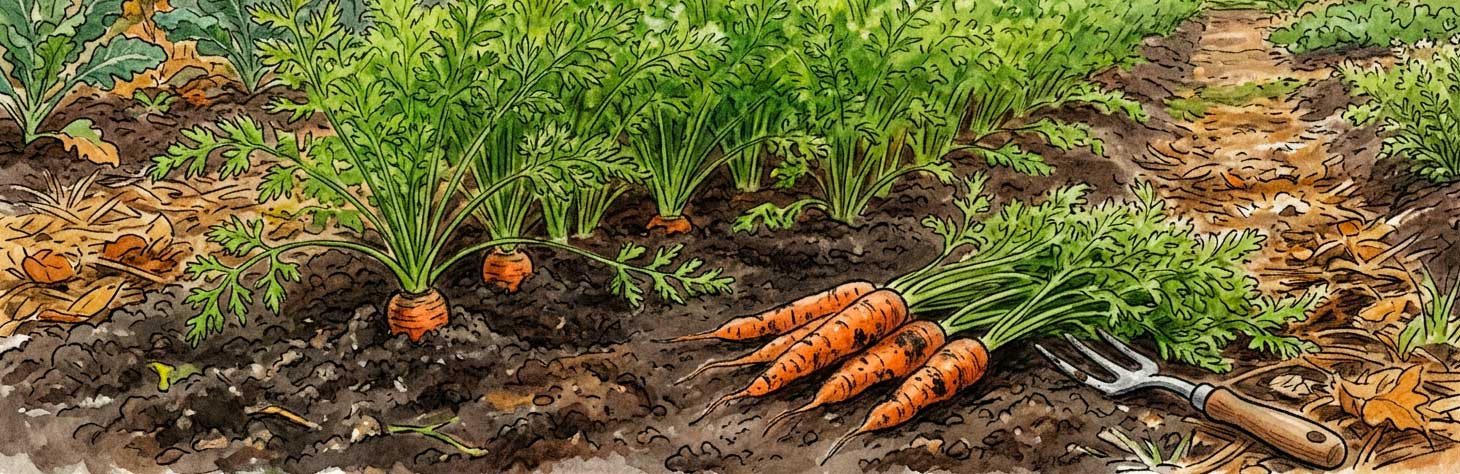
Let's look on the bright side: at least there are carrots. Yes, even with the leaves in plain sight, I was starting to have doubts (six months is a long time). They're pretty, straight, not wonky at all. Just very, very small.
Did I pull them too early? No. I probably didn't thin them enough.
The confession: I didn't dare thin them
Well, there it is. When I sowed them in March, I was so happy to see all those little shoots come up (unlike some other sowings that never appeared at all: let's be honest, I'm still waiting for my sorrel…) that guilt got the better of me. No, no, we won't thin too much, they'll have plenty of room down there.
They didn't.
Oh well, lesson learned for next year.
Thinning has to be done. Without remorse.
Why are my carrots so small?
Carrot seeds are tiny. Sown by hand, they very easily end up far too close together.
That's why thinning young seedlings is recommended, and I can confirm: you have to do it, without remorse. Young carrots should be spaced about 5 to 7 cm (2 to 3 inches) apart.
It makes sense. If the root has room, it grows. Stones in the soil? It goes wonky trying to get around them (when it manages). Too many neighbours pressed up against it? You get baby carrots. Packed in like sardines, they fight over light, water, nutrients and, above all, space in the soil.
Of course, a lack of thinning isn't the only possible explanation. Compacted soil, too little water during growth or the variety you chose can also affect root size.
But in my case, looking at how crowded that row is… I have my suspicions.
Do you have to harvest them all at once?
Not at all.
A carrot is a biennial: it lives two years, sets seed, then dies. So there's no rush to pull it up. Same comparison as the tomato: a tomato that goes past red is done for. A carrot just carries on quietly underground. Far better than in my fridge, anyway.
A carrot can be harvested as soon as it's big enough to eat, and there's no need to clear the whole row in one go. You take what you need and leave the rest to grow.
Well, that's the theory. In real life, nobody digs six holes in the middle of the row to take six carrots. But in principle, the more room the remaining carrots have, the bigger they can get.
Don't get your hopes up too high, though: in October, growth slows down as temperatures and daylight drop. A tiny carrot won't turn into a giant in a few weeks. But since they can stay where they are, nothing forces me to pull them all up now.
The soil, the best larder there is
This is probably my favourite part.
We often think that in autumn, everything has to be harvested and then stored somehow in the house, the cellar or the fridge. Sometimes with rather convoluted methods: digging a pit in the garden and filling it with carrots, turnips and sand (yes, really, I read it somewhere!). Or, as my grandfather used to do, a crate full of sand in the cellar with the carrots tucked inside.
Me, I'm not going to bother getting the canner out when the carrots are perfectly happy where they are. In the right conditions, they can stay in the ground until the end of winter.
But protect the row
Leaving carrots in the ground doesn't mean forgetting about them until spring.
When the frosts get serious, a good insulating layer makes all the difference. Mulch about 15 cm (6 inches) deep (straw, cardboard, dry leaves), held in place with a net or fleece if needed. This layer mainly keeps the soil from freezing, so you can keep lifting roots without attacking frozen ground with a jackhammer.
This method does have its limits:
- The soil must drain well. If the plot gets waterlogged over winter, the carrots may rot. In that case it's better to lift them and store them another way (long live grandpa's crate).
- Rodents love the idea. In gardens where voles and other root lovers are plentiful, your larder can quickly turn into an all-you-can-eat buffet.
Watch out
At the end of winter, carrots left in the ground wake up for their second year: they start growing leaves again in order to flower, and the root turns tough and woody. Make sure you harvest the whole row before growth starts again.