There are administrative documents you'd never imagine being gripping. Nearly all of them. Even the historic ones.
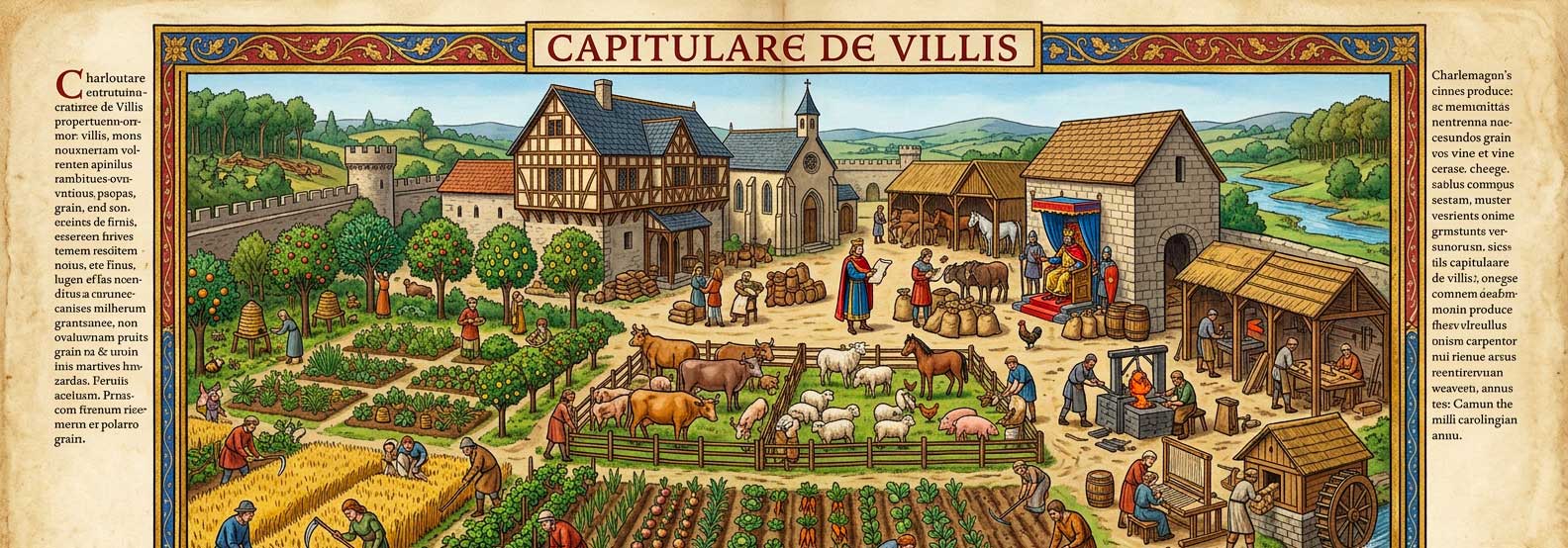
The Capitulare de villis deals with blacksmiths, goldsmiths, carpenters, soap-makers, bakers, brewers and miners. It regulates hunting, butchery, textiles, education, and even the queen's authority.
And in the middle of all that, it lists ninety-four plants.
The Capitulare de villis is probably the first official text describing what a garden should be. Throughout the Middle Ages it served as a reference.
An owner's rulebook, not a law
Its full name is Capitulare de villis vel curtis imperii, the capitulary concerning the estates and courts of the empire. It dates from the late eighth or early ninth century, and runs to seventy articles, the famous capitula.
One detail helps date it a little more closely: the text says imperii, empire, and not regni, kingdom. So it was probably drawn up after Charlemagne's imperial coronation at Christmas in the year 800.
It addresses the villici, the governors of the royal estates, and its application was checked by the missi dominici, the envoys of the master.
A point many articles overlook
This is not a general law on the kingdom's agriculture. It's a domestic rulebook for crown lands. Charlemagne isn't organising the Frankish peasant's garden. He's organising his own.
And he probably didn't write it himself. A text covering hunting with hounds, medicine, botany, weaving and accountancy doesn't come out of a single head. It's a collective work, and scholars today lean towards a compilation directed by Alcuin, the Anglo-Saxon scholar attached to the court.
Why did power care about carrots?
That's the real question, and the answer says a great deal about the period.
Because the estates were the state budget
There was no regular taxation in the sense we understand it, and no developed money economy. The sovereign didn't live off a public treasury: he lived off his land. Running the estates well wasn't a matter of housekeeping, it was a matter of public finance.
Because the court moved around
Carolingian power was itinerant. The emperor and his retinue travelled from one estate to another, consuming on the spot. Each villa had to be capable of feeding several hundred people at short notice when the court turned up. Without so much as an email in advance. A badly run estate meant a hungry court.
Because there was no pharmacy and no supply chain
Treating illness meant growing your own remedies. Clothing people meant growing your own fibres and dyes. Eating meant producing. The garden's three functions, to feed, to heal and to clothe, aren't a neat turn of phrase: they were a condition of survival.
And because Charlemagne wanted the world written down
The capitulary belongs to what we call the Carolingian renaissance. Copying, compiling, standardising, gathering the ancient knowledge scattered through the monasteries. The list in chapter 70 isn't an innovation either: it draws heavily on older sources, Pliny above all, available in the libraries of the time.
In other words, this text is also a political gesture. Writing down what must grow is a way of asserting that you control the territory right down to its flowerbeds. This does come from the man who invented the school, let's not forget.
Three gardens, three functions
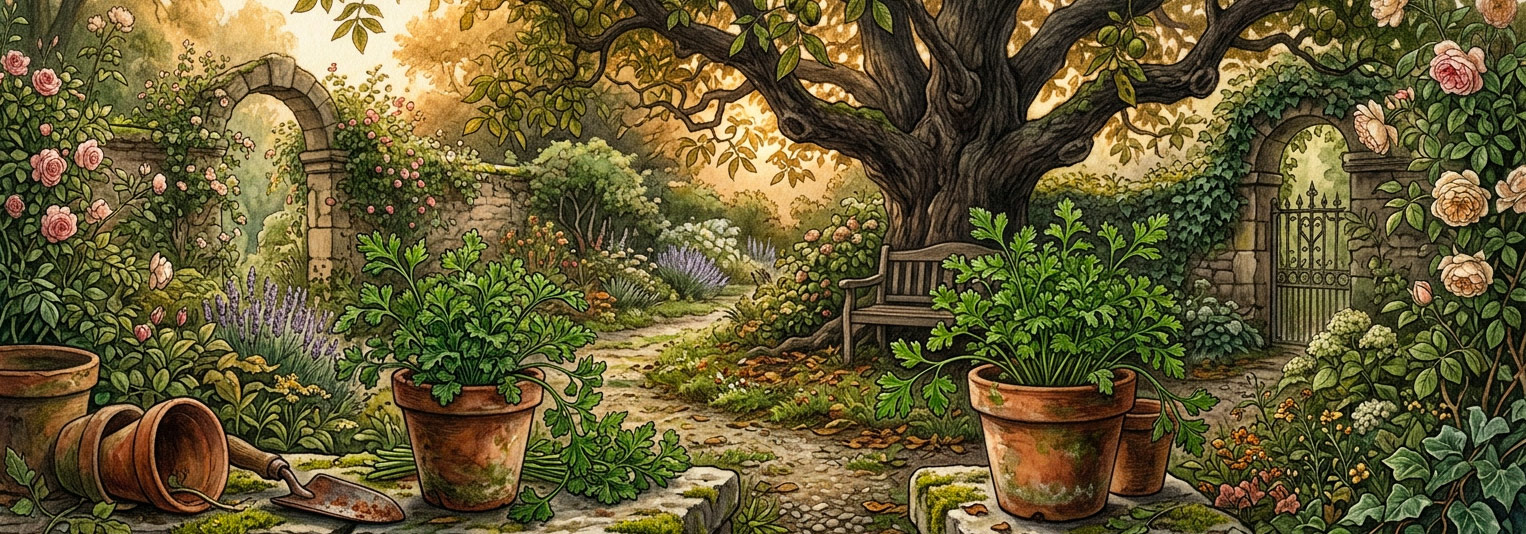
The capitulary clearly distinguishes three spaces, and it's the first time gardens are named and defined this way.
- The herbularius, the physic garden. Medicinal, aromatic and culinary plants. The distinction between remedy and seasoning doesn't mean much at this date: most plants serve both.
- The hortus, the kitchen garden. Literally the enclosure. The garden that feeds.
- The viridarium, the orchard. Planted also with vines, hornbeam and box. It may develop into a pleasure garden, but it still has to earn its keep in food. Let's not get carried away.
The herbs: seventy-three plants
This is by far the fullest part of the list.
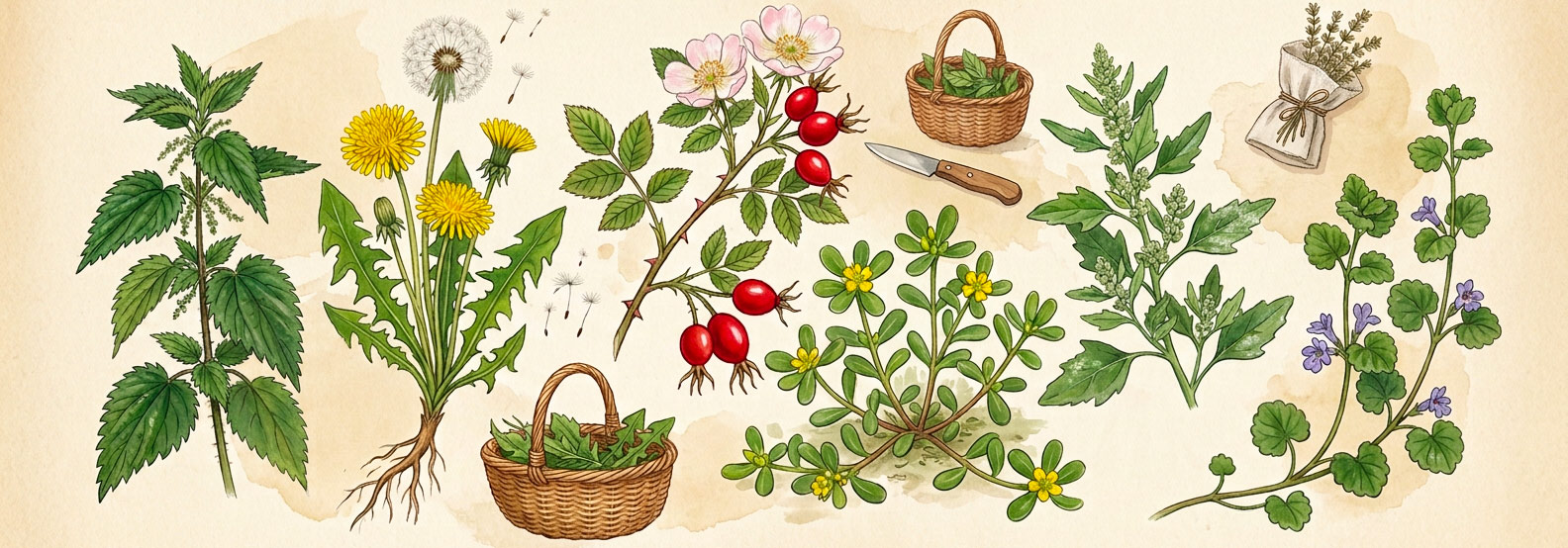
You'll find names you probably have in the garden: sage, fennel, mint, rosemary, savory, aniseed, caraway, tarragon, cumin, rue, roses and lilies.
Others have become distinctly rarer: lovage, southernwood, marshmallow, fenugreek, pennyroyal, wintercress, catmint, caper spurge, dittany of Crete.
The list cheerfully mixes what we now keep apart. The roses and lilies aren't there to look pretty: they're medicinal plants in their own right. Fennel seasons and treats. Mint scents and aids digestion.

The fruit trees: sixteen species
Here the list is precise, and the capitulary asks for several of each.
Walnut, hazel, apple, pear, plum, service tree, medlar, sweet chestnut, peach, quince, almond, mulberry, bay, pine, fig, cherry.
Two things stand out.
First, the climatic ambition. Fig, almond, peach, bay: these trees don't grow everywhere in the empire. But the empire stretched from Germany to Spain, and the text applied to all of it.
Second, today's absentees. The service tree and the medlar have left our orchards, even though they were once compulsory. Their fruit has one fatal flaw for us: it has to be bletted, left to soften after the first frosts before it can be eaten. A perfectly acceptable constraint when you have nothing else in December, far less so when the supermarket sells strawberries all year round.
As for the pine, it's there for its nuts. And the mulberry, which does sit among the fruit trees, for its berries: they were eaten, and they also yielded a dye. Silk wouldn't reach France for another seven centuries.
Fibre and dye plants: five species
This is the most forgotten part, and the one that best tells the story of the period.
Flax and hemp supply the fibres. Woad gives blue. Madder gives red. And the fuller's teasel is used to raise the nap on cloth.
So an estate had to be able to clothe its people from end to end: grow the fibre, spin it, dye it, finish it. Not one of those steps depended on an outside supplier.
"We've grown used to thinking of the garden as a supplement. For them it was infrastructure."
And then there's the houseleek
Chapter 70 ends with an instruction to the gardener: let him grow houseleek on the roof of his house.
Sempervivum tectorum, the common houseleek. A succulent that settles into the smallest crevice, shrugs off drought and asks nothing of anyone.
Why on the roof? Because it was believed to protect the house from lightning.
Here's an imperial text that organises butchery, payments in kind, estate justice and education, and that ends on a superstition. I find that wonderful. It ought to be taught in schools: texts are witnesses to their own time. Someone, one day, will have a good laugh at our own legislative shortcuts.
What remains of it
Only one original manuscript has survived. It's held at the Herzog August Library in Wolfenbüttel, Lower Saxony, and runs to about forty pages.
As for gardens, several reconstructions exist and can be visited: the abbey of Saint-Benoît-sur-Loire, the Carolingian garden at Melle in the Deux-Sèvres, the monastic garden at Tusson in the Charente. Their layout often draws on the ninth-century plan of the abbey of Saint Gall, in Switzerland.
And above all there remains this list, still circulating twelve centuries later.
We don't really know how far it was ever applied. Capitularies stated what ought to be, not necessarily what was. But someone, at some point, took the trouble to write that an empire needs sage, madder and a medlar tree, in every garden.
That strikes me as rather a fine idea of what power is for.