When we talk about aromatic plants, we usually think of parsley, thyme or basil. And yet you can also grow plants you know mainly by their scent, their spice, or their name on a packet of biscuits. Patchouli, ginger, saffron...
Why not go and see what grows behind those familiar names?
That's what I'm trying this year in my greenhouse, with a few plantings that break with habit. A chance to rediscover a plant world where leaves perfume, rhizomes candy and flowers yield spices.
Plants to smell, to harvest and to transform
An aromatic garden can supply far more than the final pinch of green on a plate. In my book about these plants you also come across ingredients for drinks, for baking and for scented preparations. With recipes from around the world, because it's all very well growing amusing things, but you still have to know what to do with them afterwards.
What interests me is precisely that passage from plant to use: recognising a scent in a leaf, watching a spice you normally buy come out of the ground, understanding which part you harvest and what you can do with it.
And sometimes the discovery starts with a very simple question: what does a patchouli plant actually look like?
Patchouli: the scent grows in the leaves
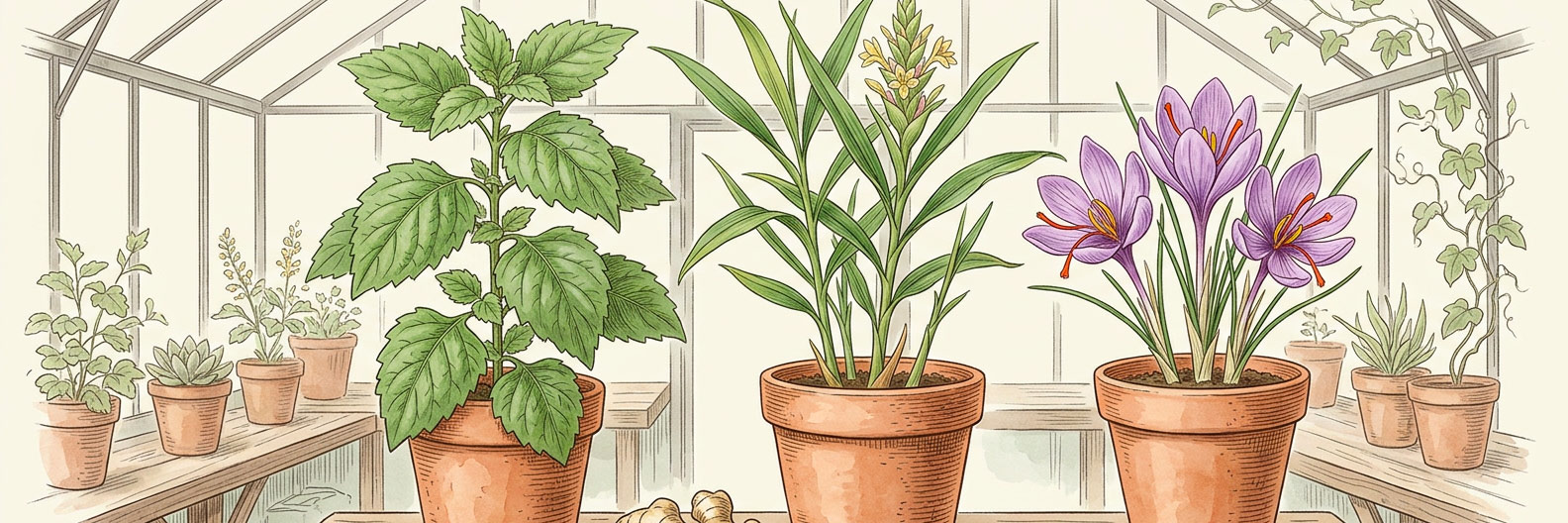
The name conjures a smell immediately. But behind the scent there's a plant: patchouli, Pogostemon cablin, with broad green leaves and a bushy habit.
The dried leaves are used, among other things, to distil the essential oil found in perfumes and soaps. Before looking into it, it wouldn't even have occurred to me that I could plant some at home. So I'm trying.
At home, you can dry a few leaves and enjoy their scent in a small sachet in a wardrobe. It's another way of harvesting from the garden: for the pleasure of the smell, and then finding it again around the house.
As for growing it, patchouli wants warmth, gentle light and a rich, free-draining substrate that stays a little moist. It's a tropical plant that needs protection from cold. I chose the greenhouse, but it does perfectly well in a pot.
Ginger: from the shop to the pot
The piece of ginger you peel in the kitchen is a rhizome, an underground stem. It carries buds capable of producing new shoots, rather like a potato.
I soon noticed that organic ginger sprouts fairly readily if you forget about it. So, off we go.
Culinary ginger, Zingiber officinale, likes warmth, light without scorching sun, and a rich soil. So, like patchouli: in a pot or under glass.
Harvesting lets you discover young ginger, more tender and less fibrous than mature rhizomes. It can flavour a soup, a drink or a vegetable dish. And to make the pleasure last, candied ginger is one of the preparations in my book: an everyday spice you look at differently once you've watched it grow.
Saffron: a few threads at the heart of a flower
Saffron holds another surprise: the spice comes from the pistils of an autumn-flowering crocus, Crocus sativus. In the middle of the mauve flower, three long branches carry the orange-red stigmas you gather carefully.
Harvesting by hand helps you understand the value of the spice. With a few plants, what you really discover is the gesture, and the pleasure of obtaining your first threads. And at that point, the astronomical price makes sense.
One confusion never to make
Autumn crocus, Colchicum autumnale, flowers at the same time and looks very similar. It is lethal, and there is no antidote. So only harvest from corms you bought as Crocus sativus and planted yourself, never a flower found in a meadow. A useful clue: saffron crocus has three stamens, autumn crocus has six.
Saffron was also used to dye fabric: colour and scent are both part of its history.
To grow it, you mainly need sun and well-drained soil. Its corms multiply over the years and can be divided. Rather nice: if you keep at it, you can build up a whole field for nothing. Unlike ginger and patchouli, it tolerates cold winters and needs no tropical conditions.
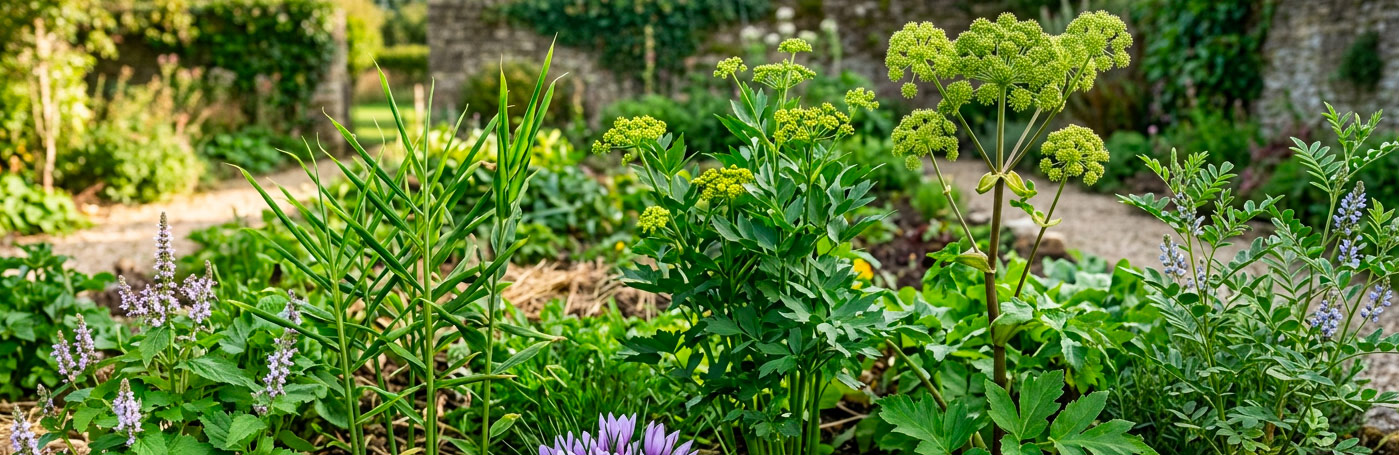
Three more aromatics worth rediscovering
These discoveries aren't limited to spices. Other, less familiar aromatic plants that I came across while researching my book make me want to try them.
Angelica, from the garden to the confectioner
The candied angelica stems you find in old baking books come from a large plant with generous umbels: Angelica archangelica. Some of its parts also go into flavouring liqueurs.
Its name recalls an old belief: an archangel is said to have revealed its properties to humankind. A story that says something about the particular place it held in tradition.
In the garden it likes ground that stays moist, and it needs room. For the kitchen, use a cultivated plant identified with certainty: it resembles other umbellifers, some of which are lethal, starting with hemlock.
Bee balm, a flower with scent as well
Bee balm, particularly Monarda didyma, catches the eye with its tousled flowers. But it also has aromatic foliage, whose scent comes out when you crush it, and edible flowers.
So it can take its place among the garden flowers as readily as among the herbs. It likes moist but well-drained soil, in sun or partial shade, and its flowering draws pollinating insects.
Lovage, for soups and broths
Lovage, Levisticum officinale, is a large aromatic perennial. Its leaves go into soups and slow-cooked dishes, and its seeds can flavour breads and cakes. Here's a plant whose uses go well beyond a few decorative leaves.
It wants deep, fertile, moist soil, in sun or partial shade. And give it space: a mature lovage can reach 2 m tall and 1 m across.
Finding room for each, in its own way
These plants can belong to the same garden of curiosities without sharing the same spot or the same watering.
"The word aromatic describes what makes them interesting. It isn't a shared set of instructions."
To start, you can choose a plant according to what you'd like to do with it: discover patchouli for its smell, follow the growth of a ginger rhizome, or wait for the saffron flowers.
A greenhouse opens up extra possibilities, but its night-time temperature is what counts for tropical plants. If it isn't heated, it doesn't necessarily replace a warm shelter in winter. Growing in pots keeps some flexibility, while separate positions make it easier to water each species as it needs.
My plantings are the start of the experiment. What remains is to watch them develop, see what settles in, and, I hope, discover the first harvests.
That's part of what I like about aromatic plants: behind a flavour or a scent you thought you knew well, there's a whole plant waiting to be discovered.