Pinching stems can encourage branching, keep the plant from sprawling everywhere, and help certain fruits ripen. But cucumbers and melons don't prune the same way, and neither needs it as a matter of routine.
Cucumber and melon vines can quickly take over a vegetable garden. Faced with all that abundant growth, the first instinct is often to reach for the pruning shears, hoping for a bigger harvest.
Pruning can indeed help. It guides the plant, prevents excessive tangling, and in some cases concentrates its resources on a limited number of fruits. But it isn't essential for every variety: over-pruning also removes leaves the plant needs for photosynthesis and creates wounds that can invite disease. Before cutting anything, start by identifying the plant, the variety, and how it's being grown.
Cucumbers and melons: same family, different pruning needs
Cucumbers and melons both belong to the genus Cucumis. Their long vines carry leaves, tendrils, male flowers, and flowers capable of producing fruit. Their behavior isn't identical, though.
In many traditional melon varieties, fruit-bearing flowers appear mainly on secondary or later side shoots. Pinching the main stem encourages these side shoots to form. Cucumbers, on the other hand, generally fruit without needing that much branching — left to sprawl on the ground, a cucumber can often be left almost entirely alone.
Pruning cucumbers becomes more useful when they're trained vertically, grown under cover, or planted in a small space. Horticultural guides for tunnel-grown cucumbers even note that they can simply be trellised with little to no pruning at all.
Should you prune cucumbers?
Grown on the ground: generally no
A cucumber grown on the soil doesn't necessarily need pruning. Its stems can root naturally at certain nodes when they touch the ground, and these new roots help feed the plant — so it's best to avoid roughly moving or flipping the vines while harvesting.
In a large vegetable garden, you can simply guide the stems so they don't smother nearby crops, remove yellow, damaged or diseased leaves, occasionally cut back a stem that's blocking a path, and harvest cucumbers very regularly. Leaving large fruit to yellow on the vine slows the formation of new cucumbers, so frequent picking is often more effective than fussy pruning for keeping production going.
On a trellis: light pruning can help
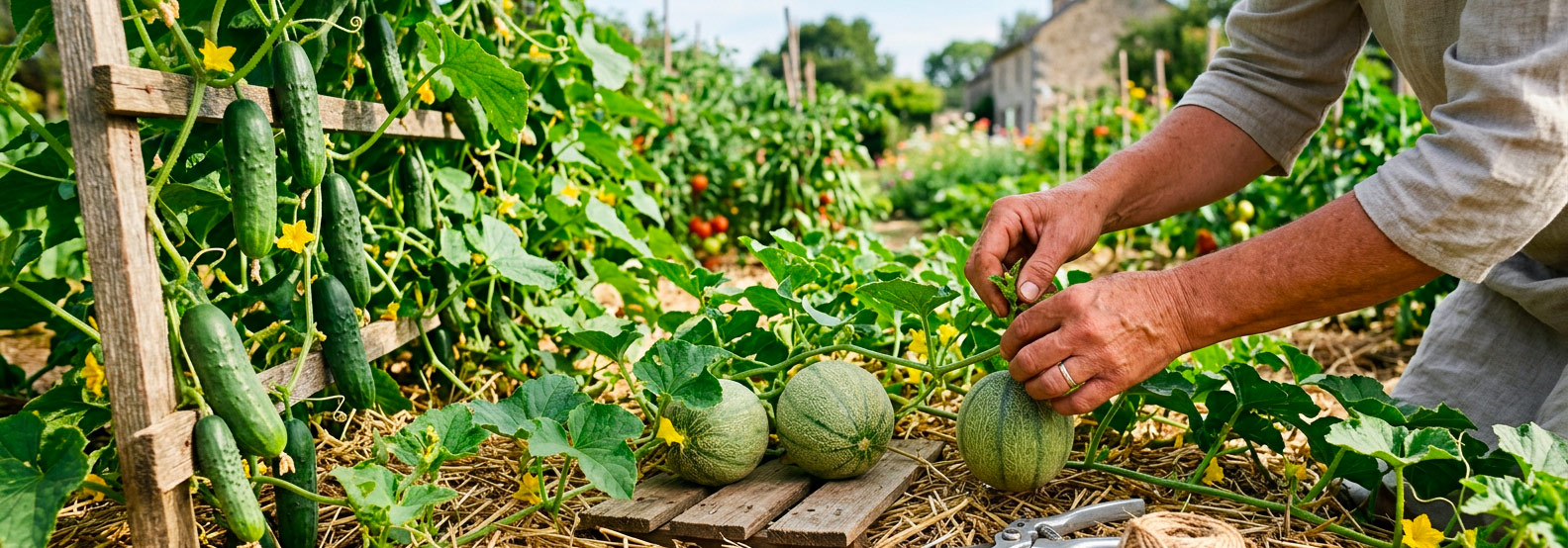
Trellising keeps fruit off the ground, makes harvesting easier, frees up space, and improves air flow around the leaves. Once the plant is tied to its support: keep one or two vigorous main stems, remove leaves that constantly touch the ground, cut out weak, damaged or badly tangled side shoots, pinch the tip once the stem reaches the top of the support, and trim overly long side shoots without removing the leaves feeding the fruit.
Under glass, some varieties are trained on a single main stem with side shoots cut back to two leaves past a forming fruit. Other varieties, particularly some outdoor cucumbers, need much less intervention.
Watch out
Modern varieties don't all behave the same way. Some have been bred to produce mostly female flowers and fruit along the main stem — pruning them the way you'd prune an older variety could remove part of the coming harvest. If the seed packet says "no pruning needed," "bush variety," or gives specific instructions, follow those instead.
How should you prune melons?
For melons, pinching is often more useful. It encourages side shoots to form and helps limit the number of fruits the plant has to ripen, which can be especially valuable in regions with a short summer.
Some recent hybrid varieties, though, are capable of fruiting without any particular pruning — the seed supplier's guidance should always take priority. The RHS itself notes that some melon varieties need no pruning at all, while others benefit from pinching.
Step one: encourage branching
On a traditional variety that needs pruning, wait until the young plant is well established and carries several true leaves. Then pinch the tip of the main stem, without touching the seed leaves, to trigger new side shoots. Keep two or three well-placed, vigorous side shoots, and remove only the weak ones or those crossing awkwardly. There's no need to aim for a perfectly precise structure — the goal is a few sturdy stems, not turning the melon into a bonsai.
Step two: support fruit formation
Once female flowers have been pollinated, a small swelling starts to grow behind the flower. Wait until the young melon reaches roughly the size of a walnut before deciding to keep it — a tiny fruit can still yellow and drop naturally if it wasn't properly fertilized.
Once a fruit is well underway: keep the best-formed melons, remove misshapen ones or those that stop growing, pinch the stem leaving generally two leaves past the fruit, and gradually remove new shoots that keep developing beyond it. This kind of pruning keeps leaves around the melon while limiting unnecessary stem growth — it's especially recommended for crops grown under cover.
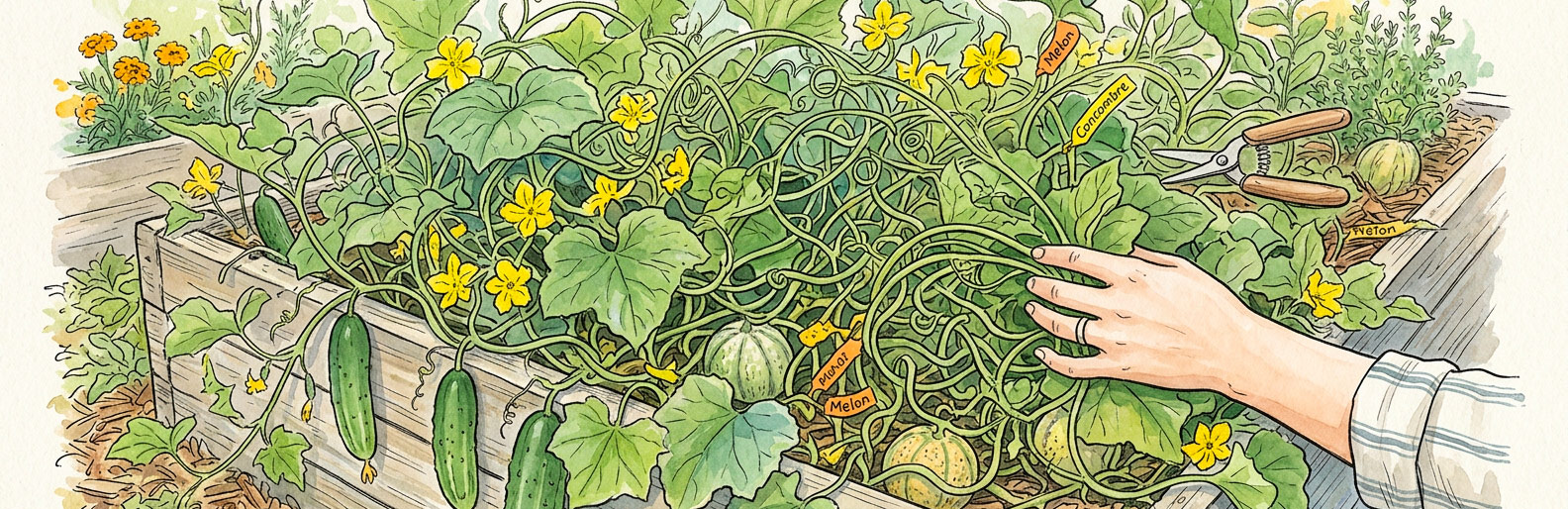
How many melons should you keep on a plant?
The number depends on the variety, the plant's vigor, how rich the soil is, and how long the season runs. For a charentais-type melon grown in the garden, keeping around four to six fruits per plant is generally a reasonable target. An especially vigorous plant can support more, while a weak or late one should be thinned further.
It's better to harvest four fully ripe melons than watch eight stay small as autumn approaches. In cooler regions, or after a late planting, limit the number of young fruit so the ones already forming can ripen before temperatures drop.
Good to know
If a melon plant has never been pruned, don't cut back a large, flower-covered plant all at once. Simply remove obviously weak or diseased stems, select the fruits with the best chance of ripening, remove very young fruit that appeared too late, pinch stem tips past the fruit you're keeping, and leave enough healthy leaves around each melon. A late, measured intervention beats one severe pruning done all at once.
When should you prune?
Choose a dry day, ideally in the morning once the dew has gone. Leaves and stems should be dry — wounds heal poorly in humid conditions and can help spread disease. Also avoid pruning during a heatwave or when the plant is short on water; pruning adds extra stress to an already weakened plant.
For small, tender tips, a pinch between thumb and forefinger is enough. For a thicker stem, use clean, sharp scissors or pruning shears, and disinfect the tool between plants, especially if one shows spots or signs of disease.
Mistakes to avoid
- Pruning every variety the same way — a hybrid, an outdoor cucumber, and an heirloom melon don't necessarily respond alike; check the seed supplier's guidance first
- Removing too many leaves — they feed the fruit and partly shield it from the sun
- Cutting main stems out of habit — in some cucumbers, fruit forms directly along the main stem, so removing it too early can reduce yield instead of improving it
- Pruning a diseased plant in humid weather — tools and hands can carry pathogens from one plant to another
- Neglecting to harvest cucumbers regularly — a forgotten fruit swells, yellows, and drains the plant's resources
What really drives a good harvest
Pruning can't make up for poor growing conditions. To produce well, cucumbers and melons mainly need warmth and sun, fertile, well-drained soil, regular watering at the base, mulch to hold moisture, good pollination, frequent picking for cucumbers, and a fruit count matched to the melon plant's vigor. Trellising can also make better use of space and keep cucumbers cleaner, without any need for heavy pruning.
"A light, thoughtful touch beats routine pruning every time. The seed packet, watching the plant, and your garden's own conditions remain the best guides."
For cucumbers, pruning is optional on the ground and mostly useful for guiding a trellised plant or managing certain greenhouse varieties. For melons, pinching often pays off on traditional varieties, since it helps the plant focus its resources on a handful of fruits. Either way, it pays to observe before you cut.